
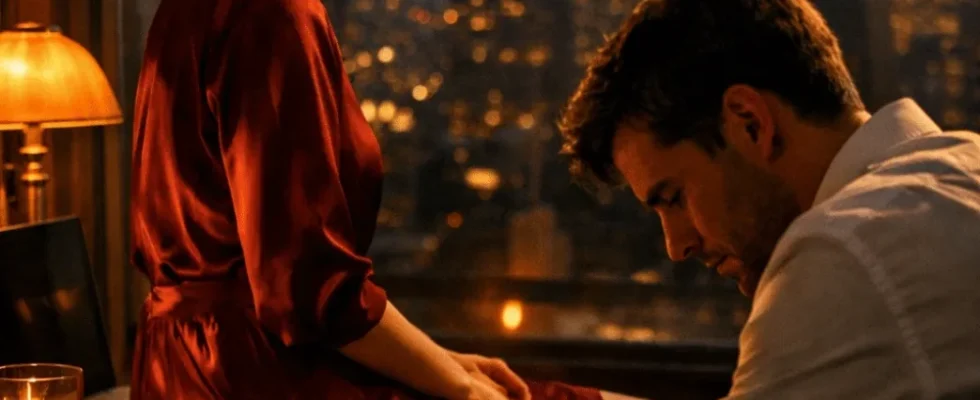
Hello, everyone! Ready to dive into a gripping drama? Today’s spotlight is on the captivating series, *Mafia Heiress’s Forbidden Obsession*, streaming exclusively on ReelShort. This series captivates audiences by brilliantly intertwining the high-stakes realm of organized crime with an emotionally charged tale of illicit love. What truly distinguishes this series is its bold fusion of genres—combining crime thriller elements with dark romance and rich character development, it weaves a narrative that dares to sidestep simple answers or traditional plot resolutions. The engaging premise centers around a twenty-year-old mafia heiress thrust into the daunting helm of her family’s criminal organization, grappling with a tumultuous attraction to a man who may be tied to her father’s death. Rather than relying on clichéd mafia tropes filled with relentless action and power struggles, the show hones in on the intricate psychological dynamics at play between Gloria and Theo, generating a tension that resonates on several layers. It appeals to discerning viewers who thirst for narrative sophistication, emphasizing mystery, romance, and moral complexity, making it an engaging experience that lingers well beyond the screen. What stands out is its courageous approach to the morally ambiguous nature of its central romance, examined with layers of nuance and depth, marking it as a must-watch for those who seek thought-provoking drama.
Advertisements
*Mafia Heiress’s Forbidden Obsession* is delivered as a short-form series tailored for the unique viewing environment of ReelShort. This format allows a distinctive pacing and intensity, setting it apart from conventional television. With fifty-seven tightly constructed episodes, each crafted to deliver emotional weight and narrative propulsion within a brief runtime, the series demands sharp writing and deliberate direction. The production quality shines through its meticulous attention to detail—from atmospheric cinematography that juxtaposes the opulent lifestyle of mafia royalty with the stifling tension of personal confrontations, to the intricate costume and production designs that illustrate Gloria’s dual roles as socialite and crime lord. The visual storytelling employs rich color schemes with contrasting cool blues and warm ambers, mirroring the emotional dynamics within the scenes, while expertly modulated editing amplifies intensity during pivotal moments, ensuring viewers remain on their toes. Notably, the series prioritizes character-driven cinematography; the camera captures subtle expressions that unveil internal struggles, elevating the narrative beyond typical genre standards.
As the storyline unfolds, it delves deep into themes of inherited power, moral decay, and the perilous dance between betrayal and affection. At its heart, *Mafia Heiress’s Forbidden Obsession* scrutinizes the weight of circumstances imposed at birth—Gloria never chose her role as mafia heiress, yet she inherits the wealth accompanied by treachery, adversaries, and moral dilemmas. It illustrates how power can corrupt even those who initially resist its allure, chronicling Gloria’s evolution from a hopeful young woman into one capable of ruthless decision-making when her family’s lineage demands it. The pivotal question of trust versus deceit arises, epitomized by the mystery entwined around whether Theo had a role in her father’s assassination, reflecting the fundamental uncertainty that jeopardizes all relationships built on secrets and unexpressed truths. What solidifies the series’ impact is its refusal to simplify morality—moral ambiguity is portrayed as a fundamental aspect of their reality, where survival often necessitates compromising principles, and love itself can become a liability. The series effectively creates a space where audiences can grapple with the complexity of character decisions, fostered by a viewership that transforms passive consumption into active engagement with the narrative.
The Burden of Power: A Legacy of Deception
The series opens with the shocking murder of Michael, Gloria’s father and the formidable leader of the Camorra family. This cataclysmic event shatters Gloria’s previously serene existence and catapults her into an unanticipated leadership role, one she is woefully unprepared to navigate. In a heart-stopping instant, the transition from privileged heiress to desperate protector occurs, plunging her into the ruthless realm of mafia governance where weakness invites exploitation and indecision leads to demise. The series deftly illustrates Gloria’s initial fragility—despite her education and affluence, she has never engaged in negotiations with rival factions, never uttered orders leading to death, nor balanced the conflicting demands of merciless men who esteem only strength and astuteness. The inciting incident extends beyond her father’s death; it encompasses the dawning realization that her command is questioned by all—can she truly lead against both internal rivals and outside threats? The cinematography accentuates Gloria’s disorientation, framing her within expansive settings that amplify her vulnerability and the immense pressure now resting heavily on her.
As the plot progresses, Gloria’s father’s enigmatic bodyguard, Theo, emerges as her sole ally—once an FBI agent, Theo’s secretive ties to Michael add further layers of intrigue. Upon discovering her picture concealed in Theo’s pendant, Gloria mistakenly believes he harbors romantic inclinations towards her, interpreting this gesture as a symbol of mutual affection rather than a reminder of his connection to her mother. This misinterpretation ignites the emotional engine driving the series forward, intertwining Gloria’s burgeoning feelings for Theo with her investigation into his involvement in her father’s demise. The series excels in its ability to intertwine these narratives—Gloria’s battle for control over her family’s operations, her emotional entanglement with a man shrouded in enigma, and her determined search for the truth together create an escalating sense of urgency, propelling characters into increasingly precarious choices. The pacing is masterfully calibrated, revealing critical information at just the right moments, compelling characters to reevaluate their motivations and ties, ensuring that emotional stakes rise steadily throughout the unfolding drama.
Gloria: The Complex Queen of Crime
Gloria stands out as a protagonist of extraordinary depth—a young woman thrust into maturity by circumstances rife with tragedy, wrestling with impossible decisions using a blend of intellect, sensitivity, and a burgeoning sense of toughness. From her first encounters, Gloria is depicted not as a typical mafia daughter—sheltered, spoiled, or indifferent to her family’s operations—but as a woman who genuinely adored her father and respected his role, while harboring inner conflicts about the ethical implications of their criminal lifestyle. The performance deftly encapsulates Gloria’s inner turmoil, showcasing her struggle to balance her natural integrity against the harsh pragmatism necessary for survival in her father’s domain. Gloria’s transformation from heartbroken daughter to strategic crime leader reflects a realization that compassion may be perceived as flaw, that vulnerability can attract predatory adversaries, and that the persona she evolves into diverges drastically from her former self. The actress imbues this journey with an impressive emotional breadth, ensuring Gloria does not fall into the cliché of a one-dimensional villain but rather illustrates each morally dubious choice as an authentic compromise of her humanity, a sacrifice made in pursuit of survival and dominion.
What elevates Gloria above the typical narratives found in mafia dramas is the series’ commitment to exploring her authentic grappling with her inherited role. She experiences deep moments of uncertainty, questioning her capacity for the cruelty her position demands, fearing she risks becoming as cold-hearted as her father, and pondering whether the price of power outweighs the loss of genuine human connection. Her relationship with Theo serves as the narrative’s emotional nucleus, encapsulating her internal struggles—drawn to him for he symbolizes a tether to her father and the comfort of stability in a chaotic existence, while simultaneously wrestling with the suspicion of ultimate betrayal. The actress masterfully conveys Gloria’s contradictions and inner conflict; viewers root for her even as they ponder her choices, sympathizing with her vulnerabilities even as they confront her potential for ruthlessness. Gloria personifies the series’ core theme: the existential question of what occurs when circumstances mold us into beings we never aspired to be, and whether love serves as a redemptive force or merely precipitates our disintegration.
Theo: The Enigmatic Protector
Theo emerges as one of the series’ most compelling character studies—a man trapped between his previous life as a federal agent and his current role as a bodyguard, with loyalties that remain perpetually ambiguous and motivations shrouded in mystery. As a thirty-four-year-old ex-FBI operative, Theo embodies both professionalism and emotional restraint, yet his ties to Michael and protective instincts towards Gloria suggest a complex attachment that transcends mere employer-employee relations. His performance captures a man adept at compartmentalizing emotions, concealing his genuine affection and entwined guilt regarding the family he now serves. Theo embodies the series’ exploration of moral intricacies—he occupies neither the space of a hero nor that of a villain but rather navigates a treacherous path, serving a criminal organization while potentially harboring allegiances to the law, safeguarding a woman he cares for while possibly concealing secrets that could shatter her world.
The emotional climax occurs when Gloria discovers her photograph in his pendant actually belongs to her mother, fundamentally altering their relationship dynamic. This revelation prompts both Gloria and the audience to reevaluate Theo’s intentions and feelings towards her. This twist illustrates how unreciprocated love and false hopes color perceptions, leading Gloria to see what she desperately wishes rather than the reality before her. Theo’s portrayal encapsulates the quiet grief of a man invested deeply in someone unattainable, straddling professional boundaries even as his heart longs to breach them, while possibly shouldering the guilt associated with the tragedy that left Gloria orphaned. His character arc unfolds with deliberate complexity, gradually revealing layers of his past, with each development challenging the audience’s interpretations of his actions and raising inquiries about redemption, accountability, and the prospects of love maturing within a framework woven with lies and obscured truths. The actor imbues Theo with a magnetic intensity, making his emotional restraint palpable, crafting a chemistry with Gloria that is genuinely fraught with danger because it is forbidden on so many levels.
Revelations and Romance: The Complicated Dance of Discovery
A defining strength of the series lies in its careful construction of the mystery surrounding Michael’s murder, allowing this central enigma to fuel character relationships and propel the narrative throughout. The series showcases that a mystery’s allure is not simply in its resolution but in how it compels characters to scrutinize one another, to withhold truths, to act upon fragmented knowledge, and to navigate connections tainted by inherent distrust. This tension is palpable in the interactions between Gloria and Theo—each dialogue brims with unspoken implications, every touch may conceal ulterior motives, every display of affection might mask darker ambitions. Cinematically, this psychological duel is depicted through framing techniques that position characters in contrasting light and shadow, symbolizing their emotional distances and mutual skepticism.
These emotionally charged moments resonantly reflect genuine human experiences—we’ve all found ourselves in relationships shadowed by suspicion, yearning for trust even while doubts linger. The series heightens these exchanges with strategic score choices and deliberate editing, allowing silence to stretch uncomfortably and compelling viewers to share in the anguish and ambivalence that define Gloria’s reality. The pacing deliberately contrasts slower, intimate scenes with rapid sequences depicting Gloria’s mafia dealings, creating a rhythm that underscores the emotional weight of her personal relationships against her criminal obligations. As viewers, we are frequently reframing perspectives, evaluating which revelations are authentic and which result from deceit, experiencing the same confusion and vulnerability that Gloria grapples with throughout the series. This narrative technique transforms the series from a mere crime drama into an intricate psychological study, investigating how information influences connections and how the absence of trust can taint even the most sincere affections.
Sourcing Success: The Perfect Fit for ReelShort
*Mafia Heiress’s Forbidden Obsession* has discovered its ideal venue on ReelShort, where the short-form episodic structure affords intense, concentrated storytelling that amplifies emotional resonance within a limited timeframe. The series flourishes within the platform’s unique viewing habits, enabling audiences to devour episodes in quick succession, allowing narrative stakes to escalate without the delays common in traditional formats that may diminish tension. The audience on this platform exhibits a particular craving for intricate romance stories that effectively blur genre boundaries—such as crime, intrigue, and dark fantasy—intertwined with honest emotional depth, and *Mafia Heiress’s Forbidden Obsession* delivers this combination with remarkable finesse. What sets it apart within ReelShort’s diverse offerings is its high production value, rivaling that of traditional television in cinematography and performance quality while maintaining the nimbleness that renders short-form content engaging. The series resonates especially with viewers aged eighteen to thirty-five, appealing to those who appreciate morally complex characters, reject the need for their protagonists to embody traditional heroism, and seek narratives that respect their intellect while delivering genuine emotional engagement. Its success underscores the growing demand for enriched narrative experiences on short-form platforms, suggesting that audiences increasingly desire nuanced storytelling that achieves both entertainment and artistic credibility.
Desire and Consequence: The Shadows of Forbidden Love
*Mafia Heiress’s Forbidden Obsession* stands as a remarkable feat in the realm of dark romantic storytelling, highlighting the potential for the subgenre to delve into genuinely nuanced psychological interactions rather than simply glorifying toxic partnerships. The series recognizes the harmful elements inherent in its primary romance yet refrains from casting judgment on its characters for their emotional choices, creating an environment for audiences to engage with and process complex sentiments surrounding love, yearning, and the capacity for self-deception. The fusion of sophisticated character exploration, gripping mystery, atmospheric visuals, and an unflinching examination of moral ambiguity culminates in a viewing experience that lingers in the mind long after the final credits roll. For those in search of drama that provokes thought, evokes emotion, and offers genuine surprises, *Mafia Heiress’s Forbidden Obsession* is essential viewing—a showcase of contemporary serialized storytelling that proves that short-form platforms can deliver narratives rich with artistic significance and emotional profundity.